A book about wealth, family, and legacy
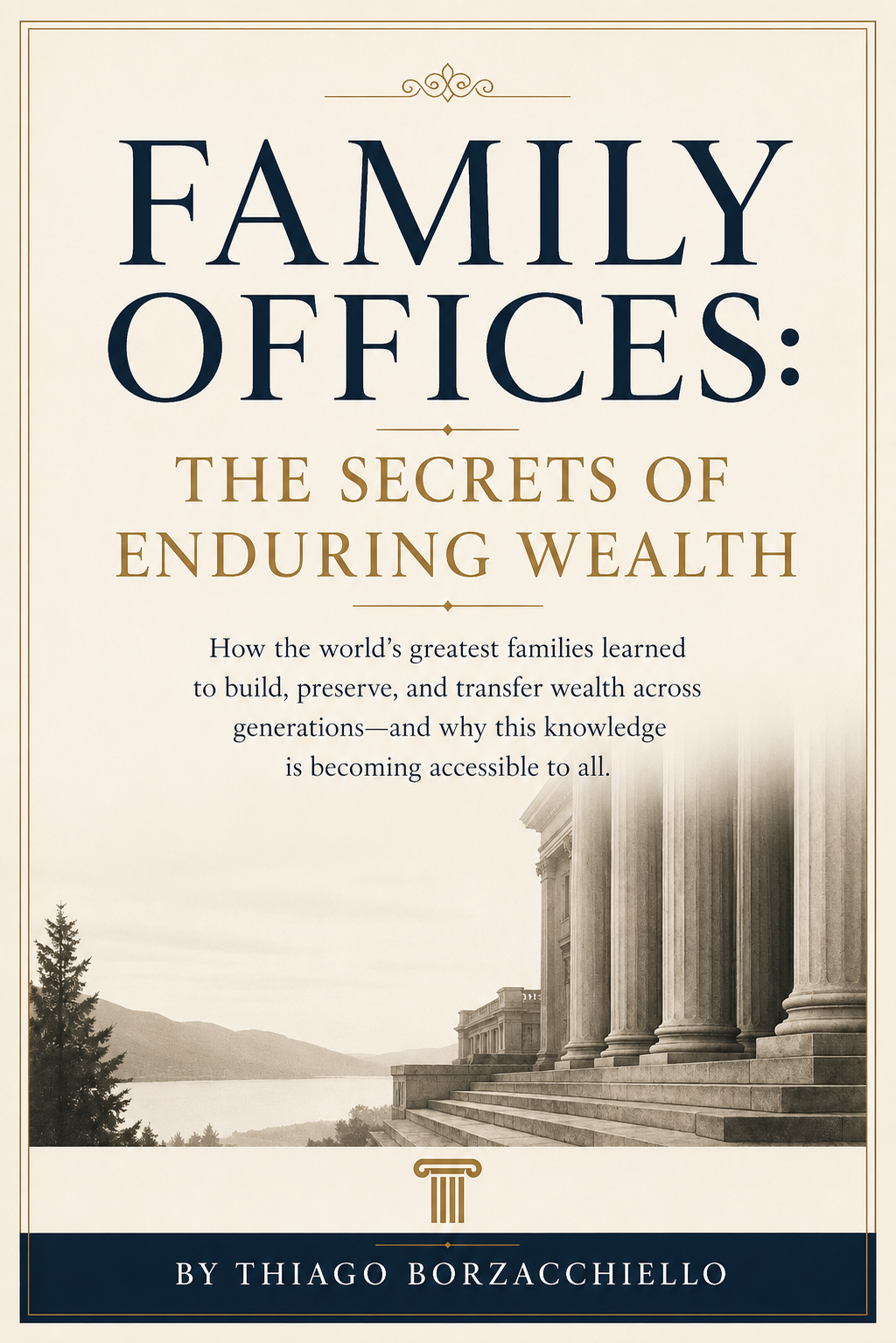
Family OfficesThe Secrets of Perpetual Wealth
How the great families — Medici, Rothschild, Rockefeller — learned to build, preserve, and pass on wealth across centuries. And why this knowledge, once reserved for billionaires, is now becoming accessible to any family willing to organize it.
Available on Amazon · Thiago Borzacchiello
A problem that crosses cultures
"Shirtsleeves to shirtsleeves in three generations." Four cultures, four continents, one warning: building wealth is hard — preserving it is even harder.
"Shirtsleeves to shirtsleeves in three generations."
"Wealth does not survive three generations."
"From rice paddy to rice paddy in three generations."
"From stables to stars and back to stables."
The book's journey
Five thousand years of wealth, summarized in one line
The book traces the history of those who created and those who lost the greatest fortunes in the world, all the way to the present.
Gold, land, and cattle
How the first wealthy people in history preserved wealth without coins, banks, or contracts.
Rome, Venice, Florence
The birth of merchant families and the first wealth managers.
The Medici
The birth of professional wealth management in Renaissance Italy.
The Rothschilds
The first international financial network in history and the art of managing wealth across countries.
Rockefeller, Carnegie, Morgan
The rise of the largest fortunes ever recorded — and a new problem: how to preserve them.
The Family Office is born
How John D. Rockefeller invented the modern structure copied by Walton, Pritzker, Mars, and Koch.
Democratization
ETFs, global brokerages, and tokenization open doors to structures once exclusive to billionaires.
AI and the digital Family Office
Intelligent agents, asset tokenization, and digital governance are reshaping wealth management.
What's inside the book
Seven parts. Twenty-four chapters. Four centuries of principles.
A structured journey from the origin of wealth to the Family Office of the future.
The history of wealth
From before money existed to the Industrial Revolution — how Rome, Venice, Florence, and the great industrial dynasties built the first fortunes.
The birth of the Family Office
How Rockefeller invented the modern model and why Walton, Pritzker, Mars, Cargill, and Koch copied it.
Far beyond investments
Family governance, councils, protocols, succession, and the legal architecture of wealth: trusts, holdings, foundations.
How they invest
The philosophy of great fortunes and the asset classes that sustain century-old estates — from stocks to art and timberland.
Philanthropy
Why virtually every great family practices philanthropy and the impact of the world's largest foundations.
The 21st century
The explosion of global wealth, the democratization of investing, and the technology reshaping the industry.
The future — and you
The Family Office of the future and how families with $1, $5, or $10 million can already access structures once reserved for billionaires.
Chapter 24
Twenty principles learned over four centuries
"Wealth can be created in one generation. Perpetual wealth must be built over many." A sample of the principles that close the book.
Wealth is a consequence, not a goal
Families that pursue only money accumulate assets. Families that pursue purpose build a legacy.
Building is different from preserving
Creating wealth requires courage. Preserving it requires discipline — and confusing the two is one of the greatest causes of wealth destruction.
Governance outweighs genius
Wealth rarely disappears due to lack of intelligence. It disappears due to lack of organization.
Succession begins before inheritance
Transferring wealth is an event. Preparing successors is a process that starts in childhood.
Time multiplies everything
Compound interest, knowledge, relationships, and reputation: everything grows when given enough time.
+ 15 complete principles in the book
Who this book is for
This is not a book just for billionaires
"The future of Family Offices does not belong only to billionaires. It belongs to every family that understands that wealth is not just money. It is responsibility."
Entrepreneurs and investors
Who have already built wealth and now need to organize, protect, and grow it with discipline.
Multi-generational families
Who want to prepare children and heirs to manage — not just receive — the family's wealth.
New millionaires
Digital entrepreneurs, doctors, lawyers, and executives who have reached seven-figure net worths.
History and finance enthusiasts
Readers who want to understand how Medici, Rothschild, and Rockefeller thought — and what that teaches us today.
True wealth is not what one generation accumulates. It is what many generations manage to honor.
Start building today the legacy your family will tell for generations.
Buy "Family Offices" on AmazonAvailable on Amazon · Thiago Borzacchiello